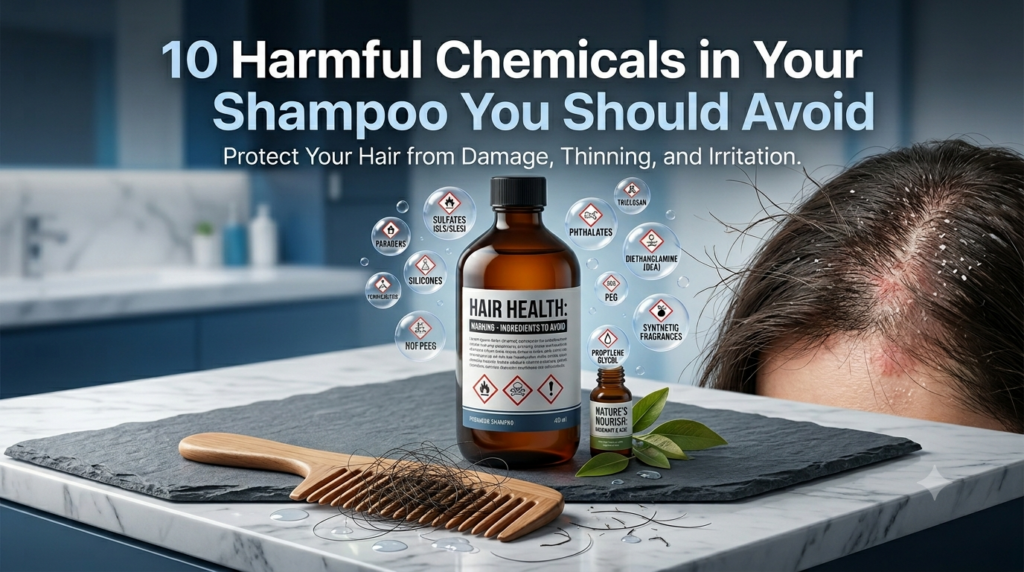
Harmful chemicals in shampoo could be the real reason behind your hair loss. Many commercial shampoos contain ingredients that strip natural oils, irritate the scalp, weaken hair follicles, and contribute to excessive hair fall over time..
Most commercial shampoos are packed with harsh chemicals that strip your scalp of its natural oils, disrupt hormone balance, and block follicle health. The worst part? They create instant lather and shine so your hair feels clean, while the damage builds underneath.
At Immer Natural Hair Centre, Indore, we see this pattern every single day. Clients who have been using popular shampoos for years unknowingly feeding their hair loss.
In this blog, we break down the 10 most harmful chemicals commonly found in shampoos, what they do to your hair and scalp, and what you should use instead.
1. Sodium Lauryl Sulfate (SLS) & Sodium Laureth Sulfate (SLES)
Found in: Almost all budget and mid-range shampoos
SLS and SLES are surfactants the chemicals responsible for that rich, foamy lather. While lather feels satisfying, it comes at a cost.
SLS is a known scalp irritant. It strips away the natural oils your scalp produces to protect and nourish hair follicles. With repeated use, this leads to a dry, inflamed scalp one of the top triggers for hair fall.
SLES is even more concerning. During manufacturing, it gets contaminated with a by-product called 1,4-dioxane a probable human carcinogen that is extremely difficult to remove.
What to look for: “Sulfate-Free” on the label. Safer alternatives include sodium cocoyl isethionate (coconut-derived).
2. Parabens (Methylparaben, Propylparaben, Butylparaben)
Found in: Most shampoos as preservatives to extend shelf life
Parabens mimic estrogen in the body. This hormonal disruption has been linked to hair thinning especially in women dealing with PCOS or hormonal imbalance.
They penetrate the skin easily and accumulate in body tissue over time. Several countries have already restricted their use in cosmetics.
What to look for: “Paraben-Free” label. Look for natural preservatives like rosemary extract or vitamin E
3. Formaldehyde & Formaldehyde-Releasing Agents
These chemicals slowly release formaldehyde over time a substance classified as a carcinogen by the International Agency for Research on Cancer (IARC).
Formaldehyde causes scalp irritation, contact dermatitis, and can weaken hair strands at the root. Long-term exposure is linked to serious health risks beyond hair loss.
Tip: These are rarely listed as ‘formaldehyde’ you must look for the releasing agents by name.
4. Synthetic Fragrances (“Fragrance” or “Parfum”)
The word ‘fragrance’ on a label is a legal loophole. A single fragrance blend can contain over 3,000 undisclosed chemicals many of which are allergens, hormone disruptors, or respiratory irritants.
For people with a sensitive scalp, synthetic fragrance is often the hidden trigger behind itching, flaking, and hair fall. It’s one of the most underestimated shampoo ingredients.
What to look for: “Fragrance-Free” or shampoos scented only with pure essential oils with full disclosure.
5. Dimethicone & Silicones
Silicones coat the hair shaft to give it that instant smooth, glossy look. But over time, they build up on the scalp and hair follicles literally clogging them.
This build-up blocks the absorption of moisture and natural oils, suffocates follicles, and contributes to scalp congestion a major barrier to healthy hair growth.
What to look for: Avoid any ingredient ending in “-cone”, “-conol”, or “-siloxane”.
6. Polyethylene Glycol (PEG Compounds)
PEGs are used as thickeners and conditioning agents. The problem: they are manufactured using a process called ethoxylation, which can leave residues of 1,4-dioxane (the same probable carcinogen found in SLES) in the final product.
PEGs also enhance skin penetration — which means they can help other harmful chemicals absorb deeper into your scalp tissue.
Tip: Avoid any ingredient with “PEG” in the name.
7. Triclosan
Triclosan is an antibacterial agent that disrupts thyroid hormone function. Thyroid imbalance is one of the leading internal causes of hair loss particularly diffuse thinning across the scalp.
Though banned in hand soaps, it is still legally present in some haircare products in India. It is also contributing to growing antimicrobial resistance concerns.
What to look for: Check ingredient lists of any anti-dandruff shampoo carefully.
8. Artificial Colours (FD&C or D&C Dyes)
Artificial dyes serve zero hair care function — they only make shampoos look more appealing. These synthetic dyes are derived from coal tar and are associated with scalp irritation, allergic reactions, and in some cases, links to carcinogens.
If your shampoo is bright red, orange, or vivid blue — that colour is almost certainly synthetic and serves no benefit to your hair.
Tip: Natural shampoos are typically brown, cream, or off-white in colour.
9. Methylisothiazolinone (MI) & Methylchloroisothiazolinone (MCI)
These are preservatives that have been flagged as strong allergens and contact sensitizers. They cause scalp inflammation, dermatitis, and in sensitive individuals, significant hair shedding.
The European Scientific Committee on Consumer Safety has restricted MCI in rinse-off products due to its allergy risk. In India, however, they are still commonly used.
What to look for: Avoid “MI” or “MCI” in any shampoo, especially if you have a sensitive scalp.
10. Alcohol (Isopropyl Alcohol, Propanol, Denatured Alcohol)
Short-chain alcohols are used as solvents and to create a light, non-greasy texture. But they are extremely drying — stripping your scalp of its essential moisture and natural oil barrier.
A dry, dehydrated scalp is a weakened scalp. Follicles without adequate sebum protection become brittle, leading to breakage and increased hair fall.
Note: Not all alcohols are bad. Long-chain fatty alcohols like cetyl alcohol or stearyl alcohol are actually conditioning. The harmful ones are the short-chain varieties listed above.
Quick Reference: Chemicals to Avoid
| Chemical | Main Harm | Safer Alternative |
| SLS / SLES | Strips scalp oils, irritant | Sodium cocoyl isethionate |
| Parabens | Hormone disruption, hair thinning | Rosemary extract, Vitamin E |
| Formaldehyde-releasers | Carcinogenic, scalp damage | Clean preservative systems |
| Synthetic Fragrance | Allergen, hormone disruptor | Pure essential oils |
| Silicones | Follicle clogging, build-up | Argan oil, shea butter |
| PEG Compounds | Carcinogen residue, penetration enhancer | Plant-based thickeners |
| Triclosan | Thyroid disruption, hair loss | Neem, tea tree oil |
| Artificial Dyes | Scalp irritation, allergen | Natural plant pigments |
| MI / MCI | Allergic dermatitis, shedding | Natural preservation |
| Isopropyl Alcohol | Dries scalp, follicle damage | Aloe vera, glycerin |
What Should You Use Instead?
At Immer Natural Hair Centre, we recommend transitioning to shampoos that are:
- Free from SLS, SLES, parabens, and synthetic fragrances
- Formulated with plant-based cleansers and herbal actives
- pH-balanced for the scalp (4.5 to 5.5)
- Enriched with natural ingredients like Bhringraj, Amla, Brahmi, and Neem
However, shampoo change alone is not enough if underlying follicle damage has already occurred. This is where our Natural Hair Regrowth Protocol works to reactivate dormant follicles and restore healthy hair growth from the root.
FAQs About Harmful Chemicals in Shampoo
Q: Can shampoo chemicals really cause hair loss?
Yes. Chemicals like SLS, parabens, and silicones directly damage scalp health by stripping natural oils, disrupting hormones, and clogging follicles all of which contribute to increased hair fall and thinning over time
Q: How do I know if my shampoo has harmful chemicals?
Check the ingredient list on the back of the bottle. Look for SLS, SLES, parabens (methyl-, propyl-, butylparaben), any ingredient with ‘PEG’, dimethicone, and ‘fragrance’ or ‘parfum’. If these appear at the top of the list, they are present in high concentrations
Q: Is sulfate-free shampoo enough to stop hair fall?
Sulfate-free shampoo is a good first step, but it is not a complete solution. If your hair follicles are already damaged or dormant, you need a targeted natural treatment protocol not just a shampoo change.
Q: Are natural shampoos effective at cleaning hair?
Yes. Natural shampoos use mild, plant-based cleansers that clean the scalp effectively without stripping it. They may produce less lather, but lather is not an indicator of how well a shampoo cleans it is simply a cosmetic effect of sulfates.
Can I reverse hair loss caused by chemical shampoos?
In many cases, yes. If the follicles are still alive but dormant, a natural reactivation protocol can restore hair growth. At Immer Natural Hair Centre, Indore, we specialise in dormant follicle reactivation using a completely chemical-free approach.
Q: What is the best shampoo for hair loss in India?
Look for shampoos that are free from SLS, SLES, parabens, and synthetic fragrance, and contain natural actives like Bhringraj, Amla, Neem, or Brahmi. However, shampoo alone cannot reverse hair loss if your follicles are already weakened or dormant, you need a professional natural treatment. At Immer Natural Hair Centre, Indore, we guide every client on the right hair care routine alongside our Natural Regrowth Protocol. Book a free consultation to get a personalised recommendation
Conclusion
Every time you wash your hair, you are either nourishing your scalp or damaging it. The difference often comes down to what is inside your shampoo bottle.
The chemicals listed in this blog are not just cosmetic concerns they are active contributors to hair loss, scalp inflammation, hormonal disruption, and long-term follicle damage.
Making the switch to natural, chemical-free hair care is one of the smartest investments you can make for your hair health.
If you are already noticing hair thinning, excessive fall, or a dry itchy scalp it may be time to go beyond shampoo changes and consult an expert.